
The Great Care Debate: Is it Time for Assisted Living or Memory Care?
The Difference Between Memory Care and Assisted Living, Explained Simply
Understanding what is memory care vs assisted living is one of the most important decisions families face when a loved one needs more support.
Here’s the short answer:
| Assisted Living | Memory Care | |
|---|---|---|
| Best for | Seniors needing help with daily tasks | Seniors with Alzheimer’s or dementia |
| Independence | High — residents move freely | Structured — supervised environment |
| Security | Standard building security | Locked units, wandering prevention |
| Staff training | General senior care | Specialized dementia training |
| Activities | Social, recreational programs | Cognitive therapies, structured routines |
| Avg. monthly cost | ~$5,419 | ~$6,690 |
Both options provide housing, meals, and help with activities of daily living (ADLs) like bathing and dressing. But they serve very different needs.
Assisted living is built around independence with support. Memory care is built around safety and cognitive care.
The average assisted living resident is about 85 years old — and nearly three-quarters of people in that age group have some form of dementia. That overlap is exactly why so many families find this choice confusing.
Getting it right matters. Choosing the wrong level of care can affect your loved one’s safety, quality of life, and your family’s peace of mind.
Defining the Basics: What is Memory Care vs Assisted Living?
To understand the core of senior living, we have to look at the goals of each care level. While they share the same roof in many communities, the philosophy of care differs significantly.
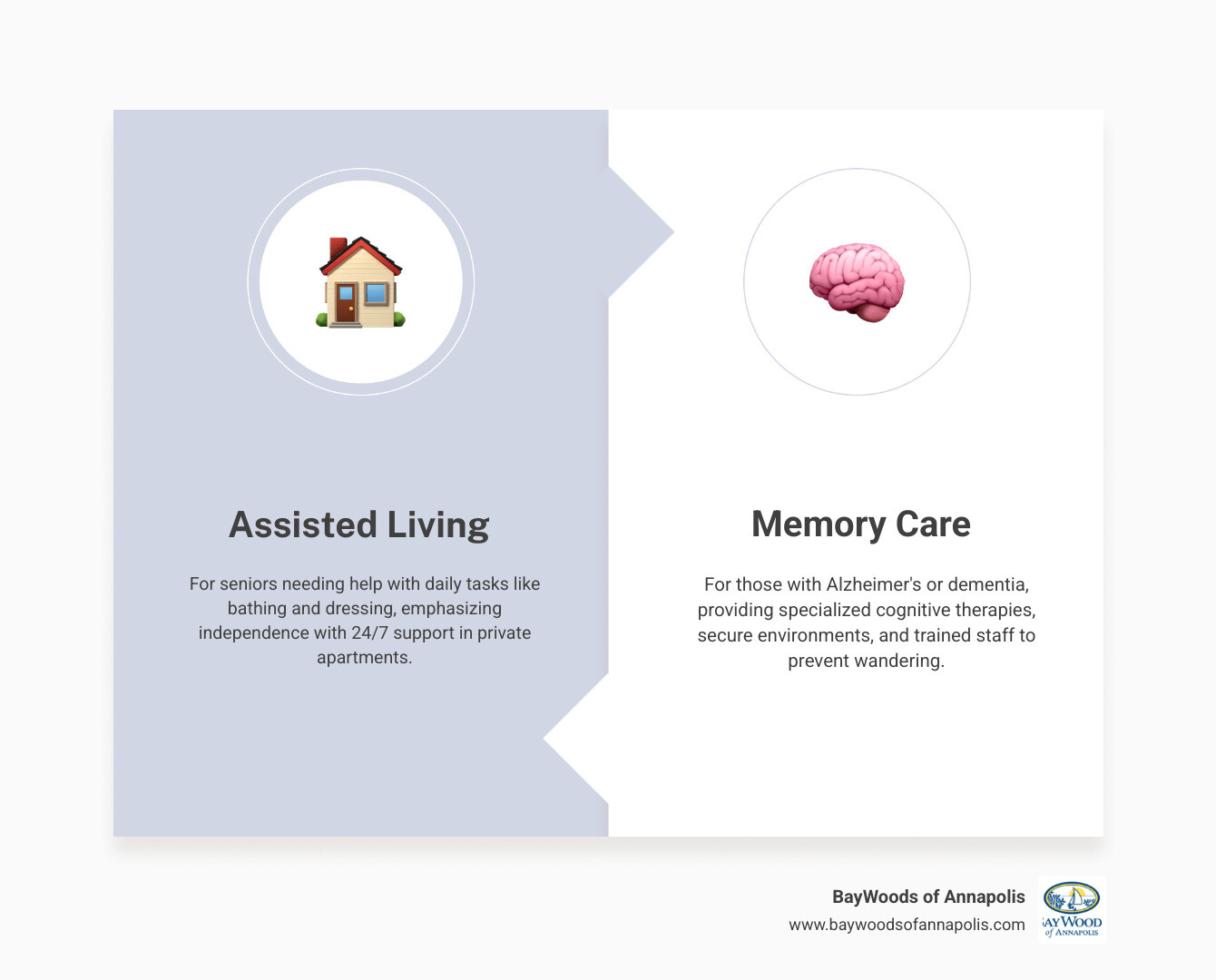
Assisted Living is designed for older adults who are still largely independent but require a “helping hand” with Activities of Daily Living (ADLs). These activities include tasks like bathing, dressing, grooming, and medication management. Residents typically live in private apartments and enjoy a vibrant social life, with the peace of mind that help is available 24/7 if they press a pendant or pull a cord.
Memory Care, on the other hand, is a specialized form of long-term care tailored specifically for those living with Alzheimer’s, vascular dementia, or other forms of cognitive impairment. While it provides the same ADL support found in assisted living, it adds a heavy layer of supervision and specialized dementia care.
In a comparison of Assisted Living vs Memory Care, the primary differentiator is the level of cognitive support. In assisted living, the resident is usually the “captain of their own ship,” deciding when to eat, which activities to attend, and when to leave the building for a walk. In memory care, the staff takes a much more active role in guiding the resident through a structured day to reduce the anxiety and confusion that often accompany memory loss.
Person-centered care is the gold standard in both settings, but in memory care, this means staff members are trained to understand a resident’s “life story”—their past career, hobbies, and preferences—to help redirect them when they become agitated or disoriented.
Key Differences in Environment, Safety, and Staffing
The physical environment of a senior living community isn’t just about decor; it’s a clinical tool. If you walk into an assisted living wing, it feels much like a high-end apartment complex or a boutique hotel. Walk into a memory care wing, and you’ll notice subtle but vital changes designed for safety and “wayfinding.”

One of the biggest differences between assisted living and memory care involves wandering management. It is estimated that 6 out of every 10 people with dementia will wander at some point. To address this, memory care units feature secure perimeters and alarmed doors to prevent “elopement” (leaving the building unsupervised).
Staffing is another major differentiator. Because residents with dementia require more “hands-on” time for redirection and safety oversight, memory care typically has higher staff-to-resident ratios. While an assisted living ratio might be 1:8 or 1:15 depending on the time of day, memory care often aims for 1:5 or 1:6 during peak hours. Furthermore, these dementia caregivers receive specialized training in behavior management, communication strategies, and sensory stimulation.
At communities providing on-site care, these environments are often distinct but connected, allowing for a “continuum of care” where a resident can move from one level to another as their needs evolve.
Safety Features in What is Memory Care vs Assisted Living
When evaluating what is memory care vs assisted living, safety is usually the deciding factor. Standard assisted living care provides basic safety like grab bars in bathrooms and emergency call systems.
Memory care takes this several steps further with:
- Keypad entries: Preventing residents from accidentally wandering into unsafe areas or out of the building.
- Enclosed courtyards: 78% of specialized memory care communities offer secure outdoor spaces so residents can enjoy sunlight and fresh air without the risk of getting lost.
- Wayfinding design: Using color-coded walls (often with a 30-point Light Reflectance Value difference) to help residents distinguish between floors and walls, reducing falls and confusion.
- GPS tracking: Some communities use wearable technology to monitor resident locations in real-time.
Comparing Costs and Financial Planning for Senior Care
Let’s talk about the “elephant in the room”: the price tag. Memory care is almost always more expensive than assisted living—usually by 20% to 50%. This premium covers the specialized training, higher staffing ratios, and enhanced security measures.
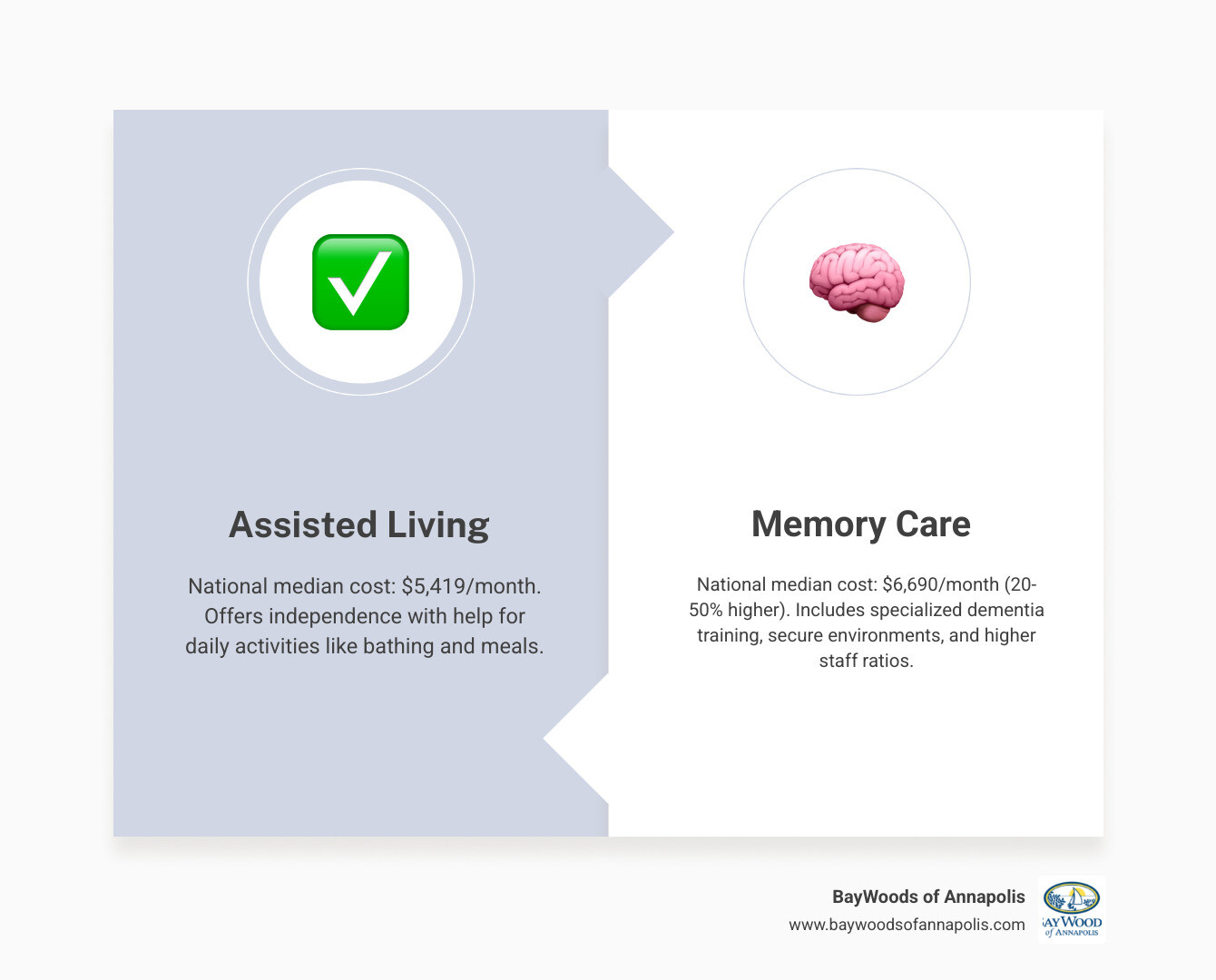
In 2026, national medians indicate that assisted living costs roughly $5,419 per month, while memory care averages $6,690. However, in high-demand areas or luxury onsite health care services providers, memory care costs can exceed $7,800 per month.
When comparing the key differences, it’s important to understand how you’ll pay:
- Private Pay: The most common method, using savings, home equity, or retirement income.
- Long-Term Care Insurance: Depending on the policy, this may cover a significant portion of the daily rate.
- Veterans Benefits: The “Aid and Attendance” benefit can provide up to $2,200 monthly for eligible veterans and spouses.
- Medicare Limitations: It is a common myth that Medicare pays for room and board in senior living. It does not. It generally only covers clinical medical services, like doctor visits or physical therapy.
- Medicaid: In Maryland, Medicaid may help cover care for those who meet strict financial and functional eligibility requirements, though not all facilities accept it.
Recognizing the Signs: When to Transition to Specialized Care
Deciding when to move a loved one is rarely a “eureka” moment; it’s usually a series of small, worrying red flags. Many families start with assisted living, but as dementia progresses, the assisted living transition to memory care becomes necessary for safety.

Key signs that it is time for memory care include:
- Wandering: If a loved one gets lost in familiar places or tries to leave the house at odd hours.
- Hygiene Decline: Forgetting how to brush teeth or refusing to bathe.
- Medication Mismanagement: Skipping doses or taking double doses because they forgot they already took them.
- Sundowning: Increased agitation, confusion, or aggression that begins as the sun goes down.
- Social Withdrawal: Avoiding activities they once loved because the cognitive load of following a conversation has become too high.
- Caregiver Burnout: When the family or current assisted living staff can no longer provide the 24/7 supervision required.
According to a distinction guide for senior care, the most telling sign is often “unmet cognitive needs.” If a resident is safe but lonely and confused in assisted living, they might actually thrive in memory care where activities are tailored to their ability level. Accessing onsite health care services ensures that medical professionals can track these changes in real-time.
Transitioning Stages: What is Memory Care vs Assisted Living for Early Dementia?
Can a person with early-stage dementia live in assisted living? Yes, and many do. There are several assisted living benefits for those in the early stages, such as social stimulation and nutritional support.
However, families should look for assisted living tips on how to monitor progression. Many communities are “hybrid,” meaning they offer both levels. This allows a resident to start in assisted living and transition to the memory care wing later without the trauma of moving to a completely new building. Regular safety assessments are vital during this stage to ensure the resident hasn’t become an “elopement risk” while living in an unsecured assisted living apartment.
Frequently Asked Questions about Senior Living Options
Does Medicare cover the cost of memory care?
No. This is one of the most frequent questions families ask at our health center. Medicare is health insurance, not long-term care insurance. It will cover “skilled” needs—like a nurse changing a wound dressing or a therapist helping with rehab after a stroke—but it will not pay for the monthly rent, meals, or 24-hour supervision provided in memory care or assisted living.
Can my loved one keep their pet in a memory care unit?
It depends on the facility and the resident’s stage of dementia. In assisted living, pets are widely welcomed. In memory care, it becomes a safety issue. A resident might forget to feed the pet, or a dog might become a tripping hazard for other residents. However, many memory care programs utilize therapy animals or have “community pets” (like a resident cat or a bird) to provide emotional support without the individual responsibility of care.
What is the average staff-to-resident ratio in memory care?
While it varies by state regulation, the goal for high-quality on-site care is typically a daytime ratio of 1:5 or 1:6. This allows for personalized attention. If a resident becomes upset, a staff member has the time to sit with them, look at a photo album, and help them calm down, rather than just rushing to the next task.
Conclusion
Choosing between assisted living and memory care is about finding the right “fit” for your loved one’s current reality. It’s a balance of honoring their independence while acknowledging the very real safety risks that come with cognitive decline.
At BayWoods of Annapolis, we understand these complexities deeply. As a resident-owned Continuing Care Retirement Community (CCRC) located on the beautiful shores of the Chesapeake Bay, we offer a unique approach to senior living. Our waterfront apartments are the largest in the region, and our resident governance ensures that the people who live here have a real say in how the community is run.
Because we provide a full continuum of care—from independent living to assisted living and specialized memory care—our residents have the security of knowing that if their needs change, their home doesn’t have to. They can continue to enjoy the maritime charm of Annapolis, MD, with the support they need to live with dignity.
If you are currently navigating the questions of what is memory care vs assisted living, you don’t have to do it alone. Learn more about our specialized Memory Care services and discover how we can provide the safety your loved one needs and the peace of mind your family deserves.